

Puppy Prep!
What do you need to be prepared?
Welcome!
The information you find here will answer most of the common questions we receive regarding Puppy Prep. Always feel free to text or email with any additional questions.
We’re excited to have you as part of our extended family! We stay in contact with many of our puppy families and look forward to watching your puppy grow with your family!
We wish you the very best!
Contents (click any topic below to go directly to that section.)
- Be sure to read our FAQ page! Some answers can be found there!
- Vaccinations!
- Dog Food Choices!
- Crate Training (Potty Training)!
- Recommended Supplies!
- Obedience Training Information
- Your First Vet Visit & More on Puppy Health!
- Worms! Important information regarding parasites.
- Free Pet Insurance For 30 Days
- Puppy Pick-up Instructions!
- One Last Note on Nutrition!

Vaccinations...
We often receive questions about vaccinations. Which shots will my puppy get before coming home? Which ones will she need? Will my vet know exactly what to do?
Will my puppy’s vaccinations be up to date?
Yes, when your new family member goes home, she’ll be up to date on vaccinations. Depending on how old your puppy is (sometimes puppies stay with us longer for training purposes or for various other reasons), your puppy will have started the customary vaccination protocol. But because your puppy will be so young (between 8 and 10 weeks), this means that she will require at least two visits to your vet once you get her home.
The Parvo vaccine, for example, has to be administered in 3 separate doses and these shots are given at least 2 weeks apart. We usually give the 1st dose at week 6 and the 2nd at week 8, which means that your little one will need the third round at about 10 or 11 weeks – probably after she’s moved home with you. It’s very important to remember that your puppy will NOT be immune to Parvo when she goes home! It won’t be safe for your puppy to freely visit outdoor locations until your vet tells you it’s ok! (Usually after the 3rd dose.)
Another example is the rabies vaccine. First, the rabies vaccine is usually given after the pup is 3-4 months old. And second, many states, Texas included, don’t allow breeders to administer rabies vaccines. This shot must be done by your vet, and usually happens between 3 and 6 months of age. Your vet will probably give your little guy a second rabies shot at around a year old.
How will my vet know what’s been administered?
Your puppy will go home with medical and shot records. We’ll have listed exactly what has been administered and when, and your vet will be able to use this information to continue his or her recommended regimen.
So what does this all mean?
We’ll begin vaccinations in the 6th week. You’ll receive medical records from us listing vaccine information, dates of deworming and microchip details that you can take with you to meet your vet. Your vet should be able to easily take over and help you grow a strong, intelligent puppy!
Let us know if you have questions.
Another note on puppy selection...
One note to consider when selecting your puppy: We greatly encourage you to weigh personality and temperament more than anything else! It’s sometimes easy to see a puppy with a “certain look”…maybe a certain color of fur or eyes or facial features. Almost always, those things change a little bit with age.
It is of course perfectly ok to prefer a boy or a girl, to look for a dog that will be a certain size at adulthood or even a specific color. BUT, we’ve never heard from a family with a complaint about a dog being slightly too red, or not red enough or that he weighed 5 or 10 pounds more than was expected. Personality and temperament, however, sometimes puppies and even young adult dogs can be challenging. If you’re less active, you probably don’t want a four legged partner that wants hikes and fetch and frisbee games! If you’re a very active person, that Doodle with perfect colors might be the most laid back, least active of the litter!
So…consider what you’d like in your new family member as far as personality and temperament go. Do you want a strong, confident, extremely friendly dog who’ll want to meet everyone who passes by? Or perhaps you like the shy, more likely to sit in the background and follow your lead kind of dog? Do you plan to travel? Visit the beach, go for hikes, jog and take adventures? Or maybe you like to burn the fireplace, read a book or watch new episodes of Outlander? Do you have young kids who’ll be on the ground playing with the new little rascal? Or maybe you’re a little older and want something a little more laid back?
Make personality and temperament high on your list and discuss this with Michele. Michele is VERY good at matching puppies with families and she’ll help you find the puppy that’s most close to perfect!
Our Dog Food Recommendation...
Perhaps the question we most often receive is “What food should we choose for our new puppy?” This is such an important topic, I’m going to start by saying this:
The food you give your new family member is the SINGLE BEST way to control his health. After choosing your puppy, this is the most important decision you’ll make. I’ve said this to many dog owners, and you may have heard me say this before: If you’ve done your research and decided to spend the money on an amazing dog, then commit to providing her with top-notch nutrition.
In the past, we’ve used Blue Buffalo, Eukanuba, Science Diet, Purina, Iams and others. We’ve also used raw food companies and continue to supplement our animals with various fresh, real, raw foods. But the food we’ve probably used most over the past decade (for both puppies and adults) is the food from Muenster Milling Company, out of Muenster, Texas. It’s an outstanding food that is terrific for all stages of development. We haven’t had any issues with this food here at the farm, with any dogs – young puppies to seniors, all breeds.
And, Muenster will ship for free for orders over $49, and you can save 5% by setting up autoship. Folks from out of state especially should definitely take advantage of this.
Muenster is a family owned business and they work very hard to use locally sourced, natural ingredients. They do some pretty neat things including meal toppers, nutritional add-ons & supplements and specialty treats. Take a look below at a video they made about the ownership EATING THEIR DOG FOOD FOR 30 DAYS! They literally put their money where their mouth is!
These are great people providing top quality foods with the best ingredients. We’ve been extremely satisfied and in case you can’t tell, we strongly recommend them.
Remember, properly feeding your puppy, especially for the first two years is so very important. I know it’s difficult, but you must make every effort to keep from over-feeding your pup as he grows. (See Purina’s Body Condition Chart here.) Additionally, it’s probably best to avoid table scraps or too many treats for the first couple years as well. If you’d like to use small treats to help you train your pup, we recommend something like this => training treats, or something like this from Muenster.
Ultimately, there are a lot of quality foods out there and it might take a couple tries to find the perfect food for your pup. But our favorite? Hands down, Muenster. Take a look at their Youtube channel to see much more information about their family, food, facilities and processes.
Please feel free to email or text with questions
Crate Training...
We encourage crate training! We’ve worked with many dog breeds over the years and all have responded well to crate training. In my experience, it’s the fastest, least frustrating way to potty train your puppy. We recommend starting with a small crate. It should be large enough for the puppy to lay down, stand and turn around, but not much larger. The puppy quickly learns not to soil his living area if he’s got nowhere else to go! A crate that’s too large will sometimes allow enough room for a pup to use the bathroom in the crate. (Some large crates come with dividers to make it smaller while your dog is a puppy. These work fine.)
Additionally, the crate becomes a safe place for the dog to stay if you need to be gone for a little while. Doodle puppies are just like any other active, smart dog – they look for things to do and get bored easily. If you leave your puppy with free rein of the home, you’ll surely return to a big mess. They’ll chew things, eat things and make a mess everywhere. We use crates even with our “in-home” adult dogs. It makes for an easy solution if pets need to be put away for a while for a visitor, for house cleaning or to simply get a time out.
A good crate is crucial, and especially if you live in an apartment or in a place where going outside will be limited, it’s a MUST while you train the pup! Here’s a link to one we like => Click here for a good starter crate!. This isn’t a cheap crate, but we’ve learned the hard way trying to find the cheapest items. Hinges break, latches don’t open and close smoothly…etc. This crate also comes with the divider. You can can use the smaller area with a younger pup and remove the divider as he grows.
Lastly, we also recommend a good crate pad for your pup. Besides being for comfort, it’s not good for the puppy’s feet to continually slide out from under him. Research suggests that not having good footing when a dog is a puppy may contribute to hip problems in the future. Here’s a link to the crate pad we like => click here. It’s an affordable item and that’s good because there’s a likelihood that your pup will eventually chew a hole in it! (Speaking of chewing, here’s a link to a company offering some amazing beds and pads that are almost indestructible => click here; and here’s a link to a post I wrote about chew toys => click here.)
If you’d like to read more about using a crate to potty train your puppy, click here to read our 3 part series, which includes step by step, hour by hour instructions!
All for now. Let us know if you have questions!
The Lost Creek Family
Recommended Doodle Supplies!
Below is a link to our Puppy Supplies page! We’ve included items that we’ve used in the past with some success, but most importantly, these are the supplies we get most questions about.
Let us know if you have questions!
The Lost Creek Family
Training Options!
Behind only nutrition, this is the best thing you can do for your new family member.
It takes commitment on your part and then patience and consistency. But if you start from the beginning, it won’t take long for you to have a well-trained dog that others will admire.
These puppies are extremely smart. This means that they learn quickly, have terrific memories & usually have a strong desire to please their humans. But if untrained, this can work against you! A smart but untrained dog left to his own creativity can create plenty of havoc. I’ve witnessed it first-hand.
So what can you do & what’s realistic?
Remember, you can do this – I promise! And I don’t simply mean “survive”. You and your new little one can THRIVE together.
We still offer our training programs here at the farm. But we don’t do it as often anymore due to the craziness in the world the past few years and because we’ve been so busy with the farm and puppies. You can see details of those programs on this page, however => click here. (Scroll to bottom of page.)
What’s often a better option, however, is the Baxter and Bella program.
Baxter & Bella is an online training program that you get for life. This is the most effective “in-home” program we’ve come across and we believe it will help many dog owners – both new puppy owners as well as families with older dogs.
Here are a few program highlights:
- LIFETIME membership.
- Unlimited live calls with trainers.
- Live training classes.
- Training videos, podcasts and printouts.
- Facebook page for discussing common training questions.
Baxter & Bella’s LIFETIME training program is only $178, if you use the code LOSTCREEK when you register. For a lifetime of manners, teaching, socialization and playtime, we encourage you to check them out!
We’ll chat again soon!
Be sure to use code LOSTCREEK to save 40%
Your 1st Vet Visit & More on Puppy Health!
This is in addition to the “Vaccinations” update above.
Depending on the age of your puppy, she will have most likely received her first 2 rounds of vaccinations. REMEMBER, she is NOT immune to the Parvo virus until after the third vaccine. The 3rd round of Parvo vaccine will be administered by your vet and they must be at least 2 weeks apart. So at her first vet visit, the vet will probably do a general exam and either give her the second round of shots, or schedule a time for you to return.
One last thing to remember in regards to visiting the vet: clinics are frequented by sick animals! We’re familiar with a number of clinics and they all do an excellent job of keeping things clean and protecting healthy animals from sick animals. But having said this, it’s always smart to be extra safe with a very young puppy. We recommend that you NOT set your pet on the floor of the clinic or on the counter. It’s best to hold the dog, keep him in a small crate or keep him in the car (car running, A/C ON!) until it’s time to see the vet. Always wash your hands and arms well when you leave, and consider cleaning the soles of your shoes once you get home.
Click here to read a little more about your first vet visit.
Worms! Important information regarding parasites.
This is important information for 2 reasons. First, it’s important for all new puppy owners to understand this:
“Nobody likes to think of their dog having worms, but there’s nothing unusual about it – in fact, your puppy or dog has probably had them at some point in their lives! … Most puppies are actually born with worms, which are contracted from their mother’s milk…” [Purina.com – click here for link to article.]
“Many pet parents that come into the office think that their dog couldn’t possibly get worms for one reason or another. But every dog is at risk for worms, no matter where they live or how much time they spend outside.” [Hector Joy, DVM, PetMD.com. Click here for link to article.]
“Just about every dog on the planet is infested with worms to some degree.” [dogtime.com – Click here for a link to the article.]
“…it would probably surprise you to know that mother dogs are most often the cause of a newborn puppies’ worms.” [Pestshero.com – Click here for the article.]
Worms and other parasites are common…almost to the point that they should be expected. A puppy can get worms several ways, including from his/her momma! Worms can be passed from mother to puppy before birth in utero, and both round worms and hook worms can be passed through the mother’s milk when nursing. And the cycle can be very difficult to break. Click here to read a little more about the subject.
So why are we telling you this? Well, and this is the second point, don’t panic if your vet tells you that your puppy has worms. While it’s not routine, it does happen, and sometimes new puppy parents are surprised to get this news. It doesn’t mean the puppy is unhealthy and it doesn’t mean the puppy was raised in poor conditions. Rather, it’s a fairly common situation and is pretty normal in an environment like ours.
We raise our puppies on a farm. We like to offer as much socialization as possible and therefore will usually try to get the puppies plenty of fresh air and sunlight as they grow older. (Click to see Remy the 8 week old Bordoodle meeting some of the animals.) Additionally, the mommas spend LOTS of time outside, playing and getting exercise. They stay in the main yard exclusively when pregnant and nursing, but at other times they’ll often make trips with me out to the stock tank and into the big pasture to check on the goats, bees, and other things. What I’m saying is that while we have very happy, healthy animals, it’s virtually impossible to prevent our adult dogs from picking up parasites. (Click to watch some of Lotties Puppies meet some of the farm animals!)
We do our very best to break the cycle of parasites, should there be any present, before we send your puppies home. But occasionally, you may need to continue treatment for a few weeks after you get your puppy. Treatment is usually simple and affordable, and shouldn’t be hard on your puppy.
Lastly, having said all of this, we advise you to keep an eye on your pup and if you notice any of these symptoms, take him/her to the vet.
- Weight loss
- Swollen belly
- Cough
- Diarrhea (especially with blood)
- Vomiting
- Weakness or indifference (a change in behavior)
Most worms can’t be seen with the naked eye, and even though they’re common and easily treated, it can become serious, especially with a small puppy.
What about Pet Insurance?
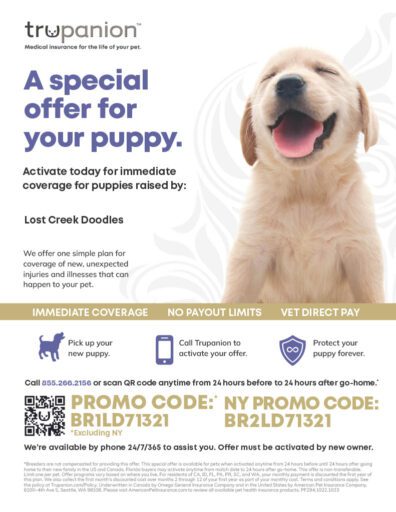
Trupanion Pet Insurance
- Enjoy 1 month of coverage!
- No upfront costs!
- You MUST activate within 24 hours of your puppy coming home!
- Use code BR1LD71321 when you activate to receive the offer!
Bringing your new puppy home is a moment you’ll never forget. With so many things to do, the last thing you want to think about is them getting into mischief. Medical insurance for pets can provide protection against the unexpected, which is why we’ve partnered with Trupanion.
With activation of your Go Home Day Offer, you gain access to immediate Trupanion policy coverage. Don’t forget to call Trupanion within 24 hours of getting your puppy to get set up! Trupanion’s Customer Care team is available 24/7/365 to assist in activating your offer, along with answering any other questions you may have. For more information about Trupanion’s policy coverage, click here.
Underwritten by American Pet Insurance Company (US) and Omega General Insurance Company (CAN).
Be sure to use CODE BR1LD71321!
That’s all for now! See you all very soon!
Puppy Pick-up Instructions - What to bring & a few things to expect.
First, the information below I copied from our FAQ page:
We can meet families here in Jacksboro, when the puppies are between 8 and 10 weeks old (depending on the litter). We don’t meet here at the farm, but rather we’ll meet at a location nearby.
We’ll begin talking with you about pick-up after you select your puppy, usually around 5 or 6 weeks of age.
We are willing to meet your family closer to your home to make your trip shorter. We charge a flat rate for delivery – $.65/mile, round trip. (Only slightly higher than the number taken directly from the Texas Comptrollers office for mileage reimbursement.) (Sometimes the rate is a little higher, depending on the route and if it involves traveling through certain cities.) We have been forced to raise delivery rates due to significant, unexpected changes in fuel price. (Click here to see an example!) Below are prices for us to meet in a few locations here in Texas or nearby. These are locations we use often:
- Dallas – $130
- DFW Airport – $110
- Waco – $200
- Abilene – $160
- Oklahoma City – $235
- Tyler – $260
- Lubbock – $300
- Austin – $325
- Midland/Odessa – $375
- San Antonio – $350
- Amarillo – $370
- Houston – $435
- Little Rock, AR – $540
For those families who live in other states, we can deliver in 3 ways:
- We’ll meet you at DFW Airport, outside at arrival/ticketing. (You pay for your transportation.) Our fee for delivering to DFW Airport is $110.
- We will bring your puppy to you. You meet us at the airport nearest you. (Price will be added to puppy total.) 50% of total cost must be paid before the trip, with remainder paid at puppy pick-up.
- We have used the Pet-Nanny service and have had terrific experiences with them. We can help you arrange this, but you pay the Pet-Nanny directly. The full balance for the puppy will be paid when the Pet-Nanny takes possession of the puppy.
- We are willing to drive farther to meet you. (We have met families in Tennessee and Denver.) We’ll charge a minimum of $.83/mile for those deliveries
Remember, puppies are like humans – some get motion sickness and some don’t. And all occasionally make messes! Here’s a list of items you should consider bringing that Michele put together for you:
- Crate – this is especially important if you’re coming alone. It’s dangerous to let the puppy move around in your vehicle if you don’t have help. We always use a crate regardless, due to potential messes.
- Old blanket to cover your car seat in case of messes!
- Towels and paper towels – for potential messes!
- Puppy pads – these actually work VERY well in crates for trips like this. We like to layer 5-10 at the bottom of the crate when we leave. If a puppy has an accident, it’s easy to just remove a layer and keep on going! (Bring a trash bag for dirty pads!)
- Baby wipes – these work amazingly well for cleaning up a puppy, or you, after an accident! And they’re usually pretty gentle.
- Water and small bowl – Your puppy should be fine unless you have a long trip to make!
- 1 can of soft puppy food. We don’t feed our puppies soft food, but this could help you should you have a long trip. The best is the Royal Canin Starter Mousse that you’ll see on the link below.
Click here to see some of our recommended items mentioned in above. (Scroll to “Items For Bringing Your Puppy Home”.)
Lastly, we usually won’t feed your puppy on the day of delivery. We do this so he or she will not have a full belly for the ride home. (Bigger messes.) So expect him/her to be hungry when you get home! Also, and this is VERY important, we suggest that you not stop to let your puppy potty in public places on the way home. Your puppy will have started vaccinations, but he/she is not immune to Parv until after the THIRD vaccination. Allowing your puppy to walk around, smell and pick things up in public places like parks or gas stations can be extremely dangerous. We prefer to just let them have their accidents in the crate, change things out and clean them up, and be on our way. It’s a little bit of a pain, but worth getting home with a healthy pup!
One last reminder: Beginning in 2022, we will only take cash at puppy pick-up! Make sure we discuss this ahead of time so you know your balance and have time to bring cash. Thank you!
Last Note on Nutrition!
You may have seen our blog post about feeding, specifically as it relates to hip dysplasia. This information is ESPECIALLY important for large and giant breeds, including medium/standard Goldendoodles. Here’s a link in case you missed it on Facebook and on our website. It’s a short read, please take the time to go back through it.
Click here => Overfeeding and Hip Displasia!
This is some of the most important information we could give you. Please let us know if you have questions.
The Lost Creek Family